
The Suffolk Business Board was established in May 2024 following the integration of New Anglia Local Enterprise Partnership functions into Suffolk County Council. It comprises representatives from business, education, the voluntary sector and local government.
Business Board members:
Chair: Mark Pendlington
Deputy Chair: Cllr Matthew Hicks, Suffolk County Council
Doug Field, East of England Co-Op
Oliver Paul, Suffolk Food Hall
Lisa Perkins, Tech East
Peter Brady, Orbital Global
Kelly Boosey, Oxford Innovation
Leanne Gittins, LME Recruitment
John Dugmore, Suffolk Chamber of Commerce
Tom Ball, Ipswich Town Football Club
Hannah Bloom, Suffolk Community Foundation
Paul Ager, Associated British Ports
Marek Hornak, University of Suffolk
Nikos Savvas, Eastern Education Group
Cllr Richard Smith MVO, Suffolk County Council
Cllr Andy Mellen, Mid Suffolk District Council
Cllr Neil MacDonald, Ipswich Borough Council
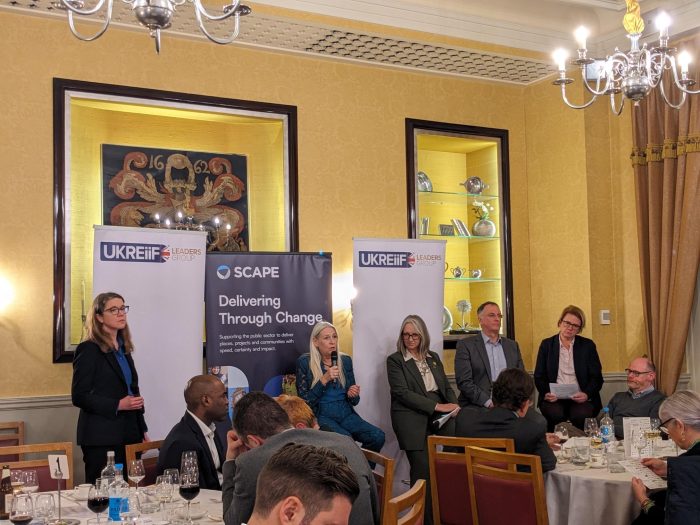
Local leaders and business representatives gathered for the UKREiiF Leaders Group dinner. Panel (from Left) Cllr Kay Mason‑Billig (Norfolk County Council Leader) Conservative, Cllr Caroline Topping (SBB member & East Suffolk DC Leader) Green, Cllr Martin Tod (Winchester City Council Leader) Lib Dem, Cllr Carli Harper (Norwich City Council Cabinet Member) Labour
Suffolk Business Board member Oliver Paul shares his takeaways from the recent UKREiiF leaders’ event, which focused on ‘The Devolution Priority Programme – What lies ahead?’
UKREiiF, now firmly established as one of the UK’s leading forums for real estate, development, and policy debate, brought national leaders together last week to confront a pressing question: how can local areas maintain economic momentum in the face of delayed Mayoral elections?
Despite the uncertainty, representatives from Suffolk and Norfolk struck a consistent optimistic tone. Business Board members and prospective mayoral candidates from across the country, along with real estate leaders, shifted the conversation away from frustration and towards opportunity — calling on regions to take ownership of their economic futures.
Delegates agreed that the delay to devolution timetables need not stall progress. Many argued the opposite: that the pause is helping galvanise local partnerships. Several business leaders noted growing appetite to “get on with delivery,” even in cases where Government support may be slow or temporarily absent. Cross‑party collaboration, they added, is becoming increasingly necessary — and increasingly visible.
Local Government Reform (LGR), devolution arrangements and the eventual establishment of Mayoral Combined Authorities remain clouded by complexity. But at the UKREiiF evening debate, the message was clear: uncertainty must not become inertia.
Across the panel sessions, there was strong consensus on the need to:
Speakers also emphasised that many local leaders, officers, and board members will remain in post long after the new governance models are finalised. Building strong relationships now, they said, is essential to ensuring regions can hit the ground running once formal devolution arrangements are implemented.
With local growth plans advancing and business communities showing renewed determination, delegates left the forum with a shared view: a delay in devolution does not have to mean a delay in development.

WHERE BIG
IDEAS HAPPEN.
